JEE Advanced | 2014FunctionMedium
Question
Let f: → R be given by f(x) = (log(secx + tanx))3. Then
→ R be given by f(x) = (log(secx + tanx))3. ThenOptions
A.f(x) is an odd function
B.f(x) is a one-one function
C.f(x) is an onto function
D.f(x) is an even function
Solution
f(x) = (log(sec x + tan x))3
f(-x)= (log(sec x - tan x))3
= log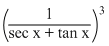
= - f(x)
∴ f is odd.
Also f′(x) = 3(log(sec x + tan x))2.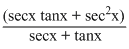
= 3 sec x . (log(sec x + tan x))2 > 0 in
∴ f is increasing on
∴ f is one-one
 (log(secx + tanx))3 → ∞ and
  (log(secx + tanx))3 → - ∞
∴ Range is R.
f(-x)= (log(sec x - tan x))3
= log
= - f(x)
∴ f is odd.
Also f′(x) = 3(log(sec x + tan x))2.
= 3 sec x . (log(sec x + tan x))2 > 0 in
∴ f is increasing on
∴ f is one-one
(log(secx + tanx))3 → ∞ and (log(secx + tanx))3 → - ∞ ∴ Range is R.
Create a free account to view solution
View Solution Free