Circular MotionMedium
Question
A spherically symmetric gravitational system of particles has a mass density ρ = 
where ρ0 is a constant. A test mass can undergo circular motion under the influence of the gravitational field of particles. Its speed V as a function of distance r (0 < r < ∞) from the centre of the system is represented by
where ρ0 is a constant. A test mass can undergo circular motion under the influence of the gravitational field of particles. Its speed V as a function of distance r (0 < r < ∞) from the centre of the system is represented by
Options
A.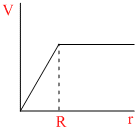
B.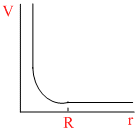
C.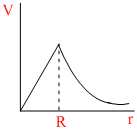
D.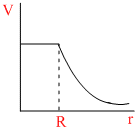
Solution
G πρ0r =
  , r ≤ R
Hence, v ∝ r
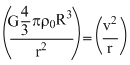 r ≥ R
r ≥ R
Hence v ∝
πρ0r = , r ≤ RHence, v ∝ r
r ≥ R Hence v ∝
Create a free account to view solution
View Solution FreeMore Circular Motion Questions
A motorcyclist of mass m is to negotiate a curve of radius r with a speed v. The minimum value of the coefficient fricti...A particle moves in a circle of radius 5 cm with constant speed and time periof 0.2 π s. The accleration of the par...The kinetic energy k of a particle moving along a circle of radius R depends on the distance covered s as k = as2 where ...A car is moving with constant speed on a road as shown in figure. The normal reaction by the road on the car is NA , NB ...A car travels with constant speed on a circular road on level ground. In the figure shown, Fair is the force of air resi...