Trigonometric EquationEasy
Question
For function f(x) = x cos  , x ≥ 1,
, x ≥ 1,Options
A.for atleast one x in interval [1, ∞), f(x + 2) - f(x) < 2
B. f′(x) = 1
f′(x) = 1C.for all x in the interval [1, ∞), f(x + 2) - f(x) > 2
D.f′(x) is strictly decreasing in the interval [1, ∞)
Solution
For f(x) = x cos  , x ≥ 1
f′(x) = cos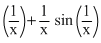 → 1 for x → ∞
also f″(x) =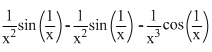
= < 0 for x ≥ 1
⇒ f′(x) is decreasing for [1, ∞)
⇒ f′(x + 2) < f′(x). Also, f(x + 2)- f(x) =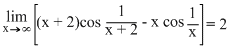
∴ f(x + 2) - f(x) > 2 ∀ x ≥ 1
, x ≥ 1f′(x) = cos
→ 1 for x → ∞ also f″(x) =
=
< 0 for x ≥ 1 ⇒ f′(x) is decreasing for [1, ∞)
⇒ f′(x + 2) < f′(x). Also,
f(x + 2)- f(x) = ∴ f(x + 2) - f(x) > 2 ∀ x ≥ 1
Create a free account to view solution
View Solution FreeMore Trigonometric Equation Questions
The value of ∫-π2π2sin2x1+2x dx is :...If 0 2θ - 5 sin θ + 2 > 0, is...If = 3 then the general solution of θ is-...The value of cos y cos -cos cos x + sin y cos + cos x sin is zero if-...If cos θ = - and π < θ < , then the value of 4 tan2 θ - 3 cosec2 θ is equal to -...