DeterminantMediumBloom L3
Question
If $a_1, a_2, a_3, \ldots, a_n, \ldots$ are in G.P., then the determinant $\Delta$ = 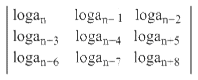 is equal to
is equal toOptions
A.1
B.0
C.4
D.2
Solution
{"given":"We have a sequence $a_1, a_2, a_3, \\ldots, a_n, \\ldots$ in geometric progression (G.P.). A determinant $\\Delta$ is formed using these terms as elements. The structure of the determinant is shown in the image.","key_observation":"For elements in geometric progression with common ratio $r$, we have $a_2 = a_1 r$, $a_3 = a_1 r^2$, and so on. When such elements form a determinant, applying appropriate column operations like $C_1 - C_2$ and $C_2 - C_3$ will create identical rows due to the proportional nature of G.P. terms. A determinant with two identical rows always equals zero.","option_analysis":[{"label":"(A)","text":"1","verdict":"incorrect","explanation":"The determinant cannot equal 1 because the geometric progression property creates dependencies between rows/columns that make the determinant zero."},{"label":"(B)","text":"0","verdict":"correct","explanation":"This is correct. When elements are in G.P., column operations $C_1 - C_2$ and $C_2 - C_3$ create identical rows, making the determinant zero by the property that determinants with identical rows equal zero."},{"label":"(C)","text":"4","verdict":"incorrect","explanation":"The determinant cannot equal 4 because the linear dependence created by the G.P. property forces the determinant to be zero regardless of the specific values."},{"label":"(D)","text":"2","verdict":"incorrect","explanation":"The determinant cannot equal 2 because when terms are in G.P., the resulting matrix has linearly dependent rows/columns, making the determinant zero."}],"answer":"(B)","formula_steps":[]}
Create a free account to view solution
View Solution FreeMore Determinant Questions
The system of linear equations x + y - z = 6, x + 2y - 3z = 14 and 2x + 5y - λz = 9 (λ ∈ R) has a unique...The system of linear equations$${x + y + z = 6 }{2x + 5y + az = 36 }{x + 2y + 3z = b }$$has...If x is a positive integers then the value of determinant is -...If D is a determinant of order three and ᐃ is a determinant formed by the cofactors of determinant D ; then...The value of the determinant is -...