Quadratic EquationHard
Question
Let (x0, y0) be solution of the following equations
(2x)ln2 = (3y)ln3
3lnx = 2lny
Then x0 is
(2x)ln2 = (3y)ln3
3lnx = 2lny
Then x0 is
Options
A.1/6
B.1/3
C.1/2
D.6
Solution
(2x)ln2 = (3y)ln3 .........(i)
3lnx = 2lny .........(ii)
⇒ (log x) (log 3) = (log y) (log 2)
⇒ log y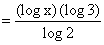 .........(iii)
In (i) taking log both sides
(log 2) {log 2 + log x} = log3{log 3 + log y}
(log 2)2 + (log 2) (log x) = (log 3)2 +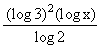 from (iii)
⇒ (log 2)2 - (log 3)2 =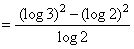 (log x) ⇒ - log 2 = log x
⇒ x = 1/2 ⇒ x0 = 1/2
3lnx = 2lny .........(ii)
⇒ (log x) (log 3) = (log y) (log 2)
⇒ log y
.........(iii)In (i) taking log both sides
(log 2) {log 2 + log x} = log3{log 3 + log y}
(log 2)2 + (log 2) (log x) = (log 3)2 +
from (iii)⇒ (log 2)2 - (log 3)2 =
(log x) ⇒ - log 2 = log x⇒ x = 1/2 ⇒ x0 = 1/2
Create a free account to view solution
View Solution FreeMore Quadratic Equation Questions
If a + b + c = 0, then the quadratic equation 3ax2 + 2bx + c = 0has...If in the equation ax2 + bx + c = 0, the sum of roots is equal to sum of squares of their reciprocals, then equals -...The roots of the equation (p − 2) x2 + 2 (p − 2) x + 2 = 0 are not real when -...Let α and β be the distinct roots of ax2 + bx + c = 0, then isequal to...Let $a,b$ are two different positive integers and the two quadratic equations $(a - 1)x^{2} - \left( a^{2} + 2 \right)x ...