Quadratic EquationEasy
Question
If 2a + 3b + 6c = 0 (a,b,c ∈ R) then the quadratic equation ax2 + bx + c = 0 has
Options
A.at least one root in [0, 1]
B.at least one root in [2, 3]
C.at least one root in [4, 5]
D.none of these
Solution
Let f(x) =  + cx ⇒ f(0) = 0 and f(1) =
  + c =
+ c = 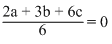
Also f(x) is continuous and differentiable in [0,1] and [0, 1[. So by Rolle’s theorem, f′(x) = 0 .
i.e. ax2 + bx + c = 0 has at least one root in [0, 1]
+ cx ⇒ f(0) = 0 and f(1) = + c = Also f(x) is continuous and differentiable in [0,1] and [0, 1[. So by Rolle’s theorem, f′(x) = 0 .
i.e. ax2 + bx + c = 0 has at least one root in [0, 1]
Create a free account to view solution
View Solution FreeMore Quadratic Equation Questions
Let the equation $x^{n} + {px}^{2} + qx + r = 0$, where $n \geq 6,r \neq 0$ has roots $\alpha_{1},\alpha_{2},\alpha_{3},...If both the roots of the equations k (6x2 + 3) + rx + 2x2 − 1= 0 and 6k (2x2 + 1) + px + 4x2 − 2 = 0 are com...If the equations x2 + 2x + 3 = 0 and ax2 + bx + c = 0, a, b, c ∈ R, have a common root, then a : b : c is :...Roots of 3x + 3−x = 10 / 3 are-...If α, β, γ are the roots of equation x3 - 2x2 + 3x - 2 = 0 then is euqal to :-...