ThermochemistryMedium
Question
If the bond dissociation energies of XY, X2 and Y2 (all diatomic molecules) are in the ratio of 1:1:0.5 and ᐃfH for the formation of XY is -200 kJ mole-1. The bond dissociation energy of X2 will be
Options
A.100 kJ mole-1
B.200 kJ mole-1
C.300 kJ mole-1
D.400 kJ mole-1
Solution
(None of the options is correct.)
XY → X(g) + Y(g) ; ᐃH = + a kJ /mole ........(i)
X22X ; ᐃH = + a kJ/mole ........(ii)
Y22Y ; ᐃH = + 0.5 a kJ/mole ........(ii)
 × (ii) + × (iii) - (i), Gives
 Y2 → XY ; ᐃH =
 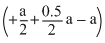 kJ / mole
 - a = - 200
a = 800.
XY → X(g) + Y(g) ; ᐃH = + a kJ /mole ........(i)
X22X ; ᐃH = + a kJ/mole ........(ii)
Y22Y ; ᐃH = + 0.5 a kJ/mole ........(ii)
× (ii) + × (iii) - (i), Gives Y2 → XY ; ᐃH = kJ / mole - a = - 200 a = 800.
Create a free account to view solution
View Solution FreeMore Thermochemistry Questions
Find the bond energy of S−S bond from the following data.C2H5 − S − C2H5(g): ΔHof = −148 kJ,C2H5 − S − S − C2H5(g): ΔHof...The enthalpy of hydrogenation of benzene is –51.0 kcal/mol. If enthalpy of hydrogenation of 1, 4-cyclohexadiene and cycl...When 1 mole of Na(s) is dissolved in large volume of water at 298 K and 1 bar, 184 kJ/mol heat is released. When 1 mole ...The Δf Ho for CO2(g), CO(g) and H2O(g) are −393.5, −110.5 and −241.8 kJ mol–1, respectively. The standard enthalpy chang...ΔH for the reaction 2C(s) + 3H2(g) → C2H6(g) is –20.24 kcal/mol. The bond energies (in kcal/mol) of C–C, C–H and H–H are...