ProbabilityMedium
Question
If E and f are independent events suents such that 0 < (E) < 1 and 0 < P (F) < 1, then
Options
A.E and F are mutually exclusive
B.E and Fc (the complement of the event F) are independent
C.Ec and Fc are independent
D.P(E / F) + P(Ec + F) = 1
Solution
Since, E and F are independent events. Therefore,
P(E ∩ F) = P(E).P(F) ≠ 0, so E and F are not mutually exclusive events.
Now, P(E ∩ ) = P(E) - P(E ∩ F)
= P(E) - P(E).P(F)
= P(E)[1- P(F)] = P(E).P()
and P( ∩ ) = P
 = 1- P(E ∪ F)
= 1-[1- P( ). P(
). P( )] (∵ E and F are independent)
= P(). P()
So, E and as well as and are independent events
Now, P(E / F) + P( / F) 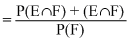

P(E ∩ F) = P(E).P(F) ≠ 0, so E and F are not mutually exclusive events.
Now, P(E ∩
) = P(E) - P(E ∩ F) = P(E) - P(E).P(F)
= P(E)[1- P(F)] = P(E).P(
)and P(
∩ ) = P = 1- P(E ∪ F) = 1-[1- P(
). P()] (∵ E and F are independent)= P(
). P() So, E and
as well as and are independent events Now, P(E / F) + P(
/ F) Create a free account to view solution
View Solution FreeMore Probability Questions
There are two bags each containing 10 different books. A student draws out any number of books (at least one) from first...3 letters are placed in 3 envelopes randomly. The probability that all letters are not in right envelopes is-...If two of the 64 squares are chosen at random on a chess board, the probability that they have a side in common is -...If the papers of 4 students can be checked by any one of the 7 teachers. Then the probability that all 4 papers are chec...A bag contains three white, two blue and four red balls. If four balls are drawn one by one with replacement, then the p...