Coordination CompoundMedium
Question
Which one of the following is an outer orbital complex and exhibits paramagnetic behaviour ?
Options
A.[ Ni(NH3)6 ]2+
B.[ Zn(NH3)6 ]2+
C.[ Cr(NH3)6 ]3+
D.[ Co(NH3)6 ]3+
Solution
Outer orbital complex utilises nd orbitals for bonding and exhibit paramagnetic behaviour, only if there present unpaired electrons.
(a) In [ Ni ( NH3)6]2+:
Ni2+ = [Ar] 3d8 4s0
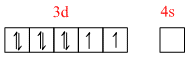
[Ni(NH3)6]2+ =
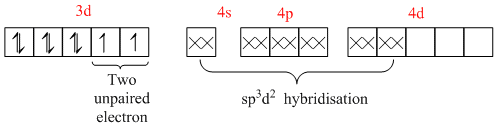
So, this is an outer orbital complex having paramagnetic character.
(b) In [ Zn ( NH3)6]2+ :
Zn2+ = [ Ar ] 3d10
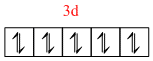
[Zn(NH3)6]2+ =
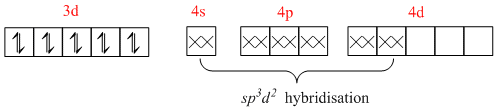
Thus, it is also an outer orbital complex but it is dimagnetic as all the electrons are paired.
(C) In [ Cr(NH3)6]3+ :
Cr3+ = [Ar]3d3
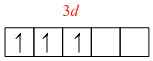
[Cr( NH3)63+ =
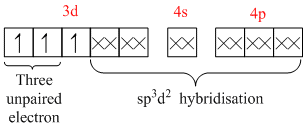
Because of the involvement of (n1)d, i.e., 3d orbital in hybridisation, it is an inner orbital complex. Its nature is paramagnetic because of the presence of three unpaired electrons.
(d) In [ Co( NH3)6]3+ :
Co3+ = [ Ar ] 3d6
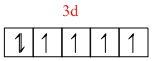
[Co(NH3)6]3+ =

As all the electrons are paired it is dimagnetic complex.
(a) In [ Ni ( NH3)6]2+:
Ni2+ = [Ar] 3d8 4s0
[Ni(NH3)6]2+ =
So, this is an outer orbital complex having paramagnetic character.
(b) In [ Zn ( NH3)6]2+ :
Zn2+ = [ Ar ] 3d10
[Zn(NH3)6]2+ =
Thus, it is also an outer orbital complex but it is dimagnetic as all the electrons are paired.
(C) In [ Cr(NH3)6]3+ :
Cr3+ = [Ar]3d3
[Cr( NH3)63+ =
Because of the involvement of (n1)d, i.e., 3d orbital in hybridisation, it is an inner orbital complex. Its nature is paramagnetic because of the presence of three unpaired electrons.
(d) In [ Co( NH3)6]3+ :
Co3+ = [ Ar ] 3d6
[Co(NH3)6]3+ =
As all the electrons are paired it is dimagnetic complex.
Create a free account to view solution
View Solution FreeMore Coordination Compound Questions
Type of isomerism exhibited by [Cr(NCS)(NH3)5] [ZnCl4]...In which case racemic mixture is obtained on mixing its mirror images in 1 : 1 molar ratio ?...Which one of the following has an optical isomer ? (en = ethylenediamine)...To obtain silver from silver amalgam, it heated in vessel which is made of -...Three arrangements are shown for the complex [Co(en) (NH3)2 Cl2]+. Pick up the wrong statement....