DeterminantHard
Question
Let f(x) = 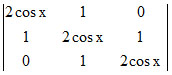 , then
, thenOptions
A.
B.maximum value of f(x) is 4
C.
D.f′(0) = 0
Solution
f(x) =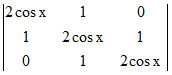
f(x) = 8cos3x - 2cosx - 2cosx = 2cos3x + 2cosx
f′(x) = - 6sin3x - 2sinx = 0
∴ f′(0) = 0 (D)
f″(x) = - 18cos3x - 2cosx < 0, at x = 0
∴ f(0)max = 2 + 2 = 4

 (2 cos 3x + 2 cos x) dx = 0
f(x) = 8cos3x - 2cosx - 2cosx = 2cos3x + 2cosx
f′(x) = - 6sin3x - 2sinx = 0
∴ f′(0) = 0 (D)
f″(x) = - 18cos3x - 2cosx < 0, at x = 0
∴ f(0)max = 2 + 2 = 4
(2 cos 3x + 2 cos x) dx = 0Create a free account to view solution
View Solution FreeMore Determinant Questions
The determinant is equal to -...The value of θ lying between and 0 ≤ A ≤ and satisfying the equation = 0 are -...If the system of equations:$${x + y + z = 5 }{x + 2y + 3z = 9 }{x + 3y + \lambda z = \mu }$$has infinitely many solution...If DP = , then D1 + D2 + D3 + D4 + D5 is equal to -...If = k , then k is equal to -...