ElectrostaticsMedium
Question
A uniform electric field of strength E exists in a region. An electron (charge −e, mass m) enters a point A with velocity Vĵ. It moves through the electric field & exits at point B.Then:
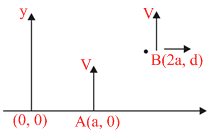
Options
A.
B.Rate of work done by the electric field at B is 
C.Rate of work by the electric field at A is zero.
D.Velocity at B is 
Solution
As velocity along y-axis remains unchanged, so there should not be any electric field along y axis.
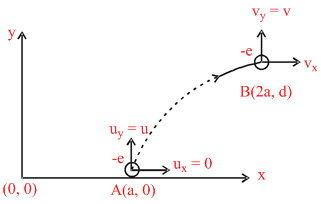
As velocity along x axis is increasing, so force on the electron must be along +x direction, so electric field must be towards −x direction.
So force on the electron is :
F = qE = eE
acceleration, a =eE/m towards +x direction
From A → B
Sy = uy t
or d = vt ⇒ ∴ tA → B =
From : A → B
Sx = ux t + axt2
axt2
or a = 0 +


⇒ E = toward-x direction ....(1)
(A) Velocity along x axis at B :
From A → B
Vx = ux + axt
or Vx = 0 +
 ⇒ Vx =
where, E = ⇒ ∴ Vx =
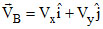
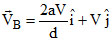
(D) Net velocity vector at B
(B) Rate of work done at B = Power =
= (eE. î) .
= eE ; where E =
⇒ ∴ P =
(C) Rate of work done at A :
PA =
= = 0
= 0
As velocity along x axis is increasing, so force on the electron must be along +x direction, so electric field must be towards −x direction.
So force on the electron is :
F = qE = eE
acceleration, a =eE/m towards +x direction
From A → B
Sy = uy t
or d = vt ⇒ ∴ tA → B =
From : A → B
Sx = ux t +
axt2or a = 0 +
⇒ E =
toward-x direction ....(1)(A) Velocity along x axis at B :
From A → B
Vx = ux + axt
or Vx = 0 +
⇒ Vx = where, E =
⇒ ∴ Vx = (D) Net velocity vector at B
(B) Rate of work done at B = Power =
= (eE. î) .
= eE
; where E = ⇒ ∴ P =
(C) Rate of work done at A :
PA =
=
= 0Create a free account to view solution
View Solution FreeMore Electrostatics Questions
The work done in rotating an electric dipole moment p in an electric field E through an angle θ from the direction ...Two balls carrying charges +7μC and −5μC attract each other with a force F. If a charge −2μC ...Two spherical conductors A and B of radii 1 mm and 2 mm are separated by a distance of 5 cm and are uniformly charged. I...Three charges, each +q, are placed at the corners of an isoscales triangle ABC of sides BC and AC, 2a. D and E are the m...A solid conducting sphere having a charge Q is surrounded by an uncharged concentric conducting hollow spherical shell. ...