JEE Advanced | 2014Gauss LawHard
Question
Let E1(r), E2(r) and E3(r) be the respective electric fields at a distance r from a point charge Q, an infinitely long wire with constant linear charge density λ, and an infinite plane with uniform surface charge density σ. If E1(r0) = E2(r0) = E3(r0) at a given distance r0, then
Options
A.Q = 4σπr02
B.r0 = 
C.E1(r0/2) = 2E2(r0/2)
D.E2(r0/2) = 4E3(r0/2)
Solution
E1(r0) =  , E1
, E1 
E2(r0) =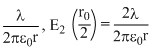
E3(r0) = E3
Now, E1(r0) = E2(r0) = E3(r0)
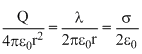
⇒
⇒ Q = 2πr2σ
⇒ = σ or r =
E1 = 4E1(r0) = 2E2
Also, E2 = 2E3(r0) = 2E3
Only C is correct.
, E1 E2(r0) =
E3(r0) = E3
Now, E1(r0) = E2(r0) = E3(r0)
⇒
⇒ Q = 2πr2σ
⇒
= σ or r = E1
= 4E1(r0) = 2E2Also, E2
= 2E3(r0) = 2E3 Only C is correct.
Create a free account to view solution
View Solution FreeMore Gauss Law Questions
Two infinitely long parallel conducting plates having surface charge density +σ and -σ respectively, are sep...The electric field at a distance of 20 cm. from the centre of a dielectric sphere of radius 10 cm. is 100 V/m. E at 3 cm...A sphere of radius R and charge Q is placed inside an imaginary sphere of radius 2R whose centre coincides with the give...Electric charges are distributed in a small volume. The flux of the electric field through a spherical surface of radius...A solid sphere of radius R has a volume charge density ρ = ρ0 r2 ( Where ρ0 is a constant and ρ0 is ...