DeterminantHard
Question
If a ≠ b, then the system of equations ax + by + bz = 0, bx + ay + bz = 0, bx + by + az = 0 will have a non-trivial solution if
Options
A.a + b = 0
B.a + 2b = 0
C.2a + b = 0
D.a + 4b = 0
Solution
Here ᐃ = 
for non-trivial solution if ᐃ = 0.
C1 → C1 + C2 + C3
(a + 2b) = 0
= 0
R2 → R2 - R1 & R3 → R3 - R1
⇒ (a + 2b)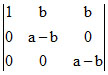 = 0
= 0
⇒ (a + 2b) (a - b)2 = 0
Here a ≠ b ∴ (a + 2b) = 0
for non-trivial solution if ᐃ = 0.
C1 → C1 + C2 + C3
(a + 2b)
= 0R2 → R2 - R1 & R3 → R3 - R1
⇒ (a + 2b)
= 0⇒ (a + 2b) (a - b)2 = 0
Here a ≠ b ∴ (a + 2b) = 0
Create a free account to view solution
View Solution FreeMore Determinant Questions
In a third order determinant each element of the first column consists of sum of two terms, each element of the second c...If I = , J = and B = , then B =...The value of k for which the set of equations 3x + ky − 2z = 0, x + ky + 3z = 0 and 2x + 3y − 4z = 0 has a n...A is a (3 × 3) diagonal matrix having integral entries such that det (A) = 120, number of such matrices is...If x is real number such that = 0 then α, β, γ, are in...