ElectroMagnetic InductionMedium
Question
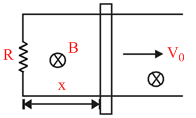
A conducting rod of length is moved at constant velocity ′v0′ on two parallel, conducting, smooth, fixed rails, that are placed in a uniform constant magnetic field B perpendicular to the plane of the rails as shown in figure. A resistance R is connected between the two ends of the rail. Then which of the following is/are correct :
Options
A.The thermal power dissipated in the resistor is equal to rate of work done by external person pulling the rod.
B.If applied external force is doubled than a part of external power increases the velocity of rod.
C.Lenz′s Law is not satisfied if the rod is accelerated by external force
D.If resistance R is doubled then power required to maintain the constant velocity v0 becomes half.
Solution
Rate of work done by external agent is :
 =
=  = BILv & thermal power dissipated in the resistor = eI = (BvL) I
clearly both are equal, hence (A) .
If applied external force is doubled, the rod will experience a net force and hence acceleration. As a result velocity increases, hence (B)
Since ; I =
On doubling ′R′, current and hence required power becomes half.
Since, P = BILv
Hence (D).
= = BILv & thermal power dissipated in the resistor = eI = (BvL) I clearly both are equal, hence (A) .
If applied external force is doubled, the rod will experience a net force and hence acceleration. As a result velocity increases, hence (B)
Since ; I =
On doubling ′R′, current and hence required power becomes half.
Since, P = BILv
Hence (D).
Create a free account to view solution
View Solution FreeMore ElectroMagnetic Induction Questions
Three capacitor of capacitance C each are connected in series as shown in the figure. Initially switch S is open. Now ca...If the rotational velocity of a motor armature is doubled, then back emf will :-...The electric generator produce electric current based on which principle :-...A rectangular loop has a sliding connector PQ of length l and resistance R Ω and it is moving with a speed v as sh...When magnetic flux through a coil is changed, the variation of induced current in the coil with time is as shown in grap...