FunctionHard
Question
If f : R → R is a function defined by f(x) = [x] cos  , where [x] denotes the greatest integer function, then f is :
, where [x] denotes the greatest integer function, then f is :Options
A.continuous only at x = 0.
B.continuous for every real x.
C.discontinuous only at x = 0.
D.discontinuous only at non-zero integralvalues of x.
Solution
[x] is contincous at R - I
∴ f(x) is continuous at R - I
Now At x = I
LHL =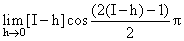
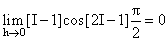
similarly,
RHL = 0 and f(I) = 0
∴ Function is continous everywhere
∴ f(x) is continuous at R - I
Now At x = I
LHL =
similarly,
RHL = 0 and f(I) = 0
∴ Function is continous everywhere
Create a free account to view solution
View Solution FreeMore Function Questions
Let $P = \left\{ \theta \in \lbrack 0,4\pi\rbrack:\tan^{2}\theta \neq 1 \right\}$ and $S = \left\{ a \in Z:2\left( \cos^...The period of f(x) = sin + 2 cos - tan , is -...Which of the following function is onto ?...Let f be a real-valued function defined on the interval (- 1, 1) such that e-xf(x) = 2 + dt, for all x ∈ (-1, 1) a...Find the values of ′a′ in the domain of the definition of the function , f(a) = for which the roots of the e...