Current Electricity and Electrical InstrumentMedium
Question
Three voltmeters, all having different resistances, are joined as shown. When some potential difference is applied across A and B, their readings are V1, V2, V3 :
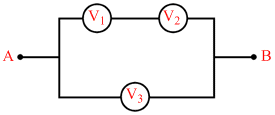
Options
A.V1 = V2
B.V1 ≠ V2
C.V1 + V2 = V3
D.V1 + V2 > V3
Solution
In parallel combination potential difference are same
So V1 + V2 = V3
Here V1 and V2 are in series but their resistances are different
So V1 = iR1
V2 = iR1
V1 ≠ V2
So V1 + V2 = V3
Here V1 and V2 are in series but their resistances are different
So V1 = iR1
V2 = iR1
V1 ≠ V2
Create a free account to view solution
View Solution FreeTopic: Current Electricity and Electrical Instrument·Practice all Current Electricity and Electrical Instrument questions
More Current Electricity and Electrical Instrument Questions
Two wires of same metal have the same length but their cross sections are Anthe ratio 3 : 1. They are joined in series. ...For the resistance network shown in the figure, choose the correct option(s)...A 25 cm long solenoid has radius 2 cm and 500 total number of turns. It carries a current of 15 A. If it isequivalent to...A galvanometer of resistance $100\Omega$ gives full scale deflection for a current of 1 mA . It is converted into an amm...If a wire is stretched to make it 0.1% longer, its resistance will :...