LimitsHard
Question
For what triplets of real numbers (a, b, c) with a ≠ 0 the function
f(x) =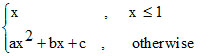 is differentiable for all real x?
f(x) =
is differentiable for all real x?Options
A.{(a, 1-2a, a) | a ∈ R, a ≠ 0}
B.{(a, 1-2a, c) | a, c ∈ R, a ≠ 0}
C.{(a, b, c) | a, b, c ∈ R, a + b + c = 1}
D.{(a, 1 - 2a, 0) | a ∈ R, a ≠ 0}
Solution
f(x) = 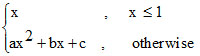
f(x) should be continous at x =1
it gives a + b + c = 1
f(x) should be differentiable at x = 1
f(x) should be continous at x =1
it gives a + b + c = 1
f(x) should be differentiable at x = 1
it gives 2a + b = 1
⇒ b =1-2a c = 1 - a - b = aCreate a free account to view solution
View Solution Free