Work, Power and EnergyMedium
Question
A man of mass m is stationary on a stationary flat car. The car can move without friction along horizontal rails. The man starts walking with velocity v relative to the car, work done by him
A man of mass m is stationary on a stationary flat car. The car can move without friction along horizontal rails. The man starts walking with velocity v relative to the car, work done by him
A man of mass m is stationary on a stationary flat car. The car can move without friction along horizontal rails. The man starts walking with velocity v relative to the car, work done by him
Options
A.is less than  mv2 if he walks along the rails
mv2 if he walks along the railsB.is equal to mv2 if he walks normal to the rails
mv2 if he walks normal to the railsC.can never be less than mv2
mv2D.is greater than mv2 if he walks along the rails
mv2 if he walks along the rails Solution
If the man walks along the rails, some velocity say V is imparted to car also. Let M be the mass of car. Then from conservation of linear momentum.
M.V = m(v – V)
∴ V =
∴ work done by man
= m (v − V)2 +
  mV2
mV2
= v2 <
v2 <  mv2
mv2
Hence, option (A) is correct. If the man moves normal to the rails then car will not move. Hence, work done by him in the case will be mv2 and option (B) is also correct.
Mathod II
Man of the mass m initially at rest on the statianary car of mass M. Now man starts walking (Let parallel to the rail) then car moves with vC
Working from the graund
MVC = m(v − VC) ⇒ VC = velocity of the car towards Left hand side
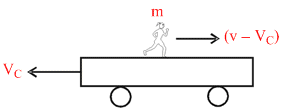
Work done by the man = (ᐃK)man + (ᐃK)car
= m (V − VC)2 +
  MV2C
MV2C
= m  +
+  MV2C
MV2C
= (M + m) V2
= <
<  MV2
MV2 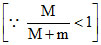
M.V = m(v – V)
∴ V =
∴ work done by man
=
m (v − V)2 + mV2=
v2 < mv2 Hence, option (A) is correct. If the man moves normal to the rails then car will not move. Hence, work done by him in the case will be
mv2 and option (B) is also correct. Mathod II
Man of the mass m initially at rest on the statianary car of mass M. Now man starts walking (Let parallel to the rail) then car moves with vC
Working from the graund
MVC = m(v − VC) ⇒ VC =
velocity of the car towards Left hand sideWork done by the man = (ᐃK)man + (ᐃK)car
=
m (V − VC)2 + MV2C =
m + MV2C =
(M + m) V2 =
< MV2 Create a free account to view solution
View Solution FreeMore Work, Power and Energy Questions
Two identical discs, each of negligible mass and radius r(l) are connected by a uniform rod of mass m and length l as sh...Energy conservation law says that :-...A particle of mass m is driven by a machine that delivers a constant power k watts. If the particle starts from rest the...Two men with weights in the ratio 5 : 3 run up a staircase in times in the ratio 11 : 9. The ratio of power of first to ...A frictionless track ABCDE ends in a circular loop of radius R. A body slides down the track from point A which is at a ...