FunctionHard
Question
Let g (x) = 1 + x - [ x ] and f (x) =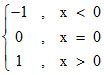 . Then for all x, f (g (x)) is equal to (where [.] denotes greatest integer function)
Options
A.x
B.1
C.f(x)
D.g(x)
Solution
g(x) = 1 + {x}
f(x) = sgn (x)
∴ f(g(x)) = sgn (1 + {x}) = 1
f(x) = sgn (x)
∴ f(g(x)) = sgn (1 + {x}) = 1
Create a free account to view solution
View Solution FreeMore Function Questions
If the domain of the function $f(x) = \sin^{- 1}\left( \frac{5 - x}{3 + 2x} \right) + \frac{1}{\log_{e}g( + 0}$ is $( - ...If f(x) = cos x + sin x, [x] denoting the greatest integer function, then -...If f: R → [ - 1, 1], where f (x) = sin , (where [.] denotes the greatest integer function), then...Domain of the function f(x) = sin-1 is -...Domain and range of f(x) = is...