Application of DerivativeHard
Question
Let f(x) = 40/(3x4 + 8x3 - 18x2 + 60). Which of the following statement(s) about f(x) is (are) correct ?
Options
A.f(x) has local minima at x = 0.
B.f(x) has local maxima at x = 0.
C.Absolute maximum value of f(x) is not defined.
D.f(x) is local maxima at x = - 3, x = 1.
Solution
f′(x) = 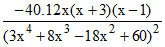
f′(x) = 0
at x = 0, x = - 3, x = 1
so at x = 0, f(x) has local minima.
and at x = - 3, x = 1 ; f(x) has local maxima
f(1) = f(- 3) =
  . f(-3) < 0, f(1) > 0 and f(x) ≠ 0
⇒ f(x) is undefined at point(s) in (-3, 1). Hence f(x) has no absolute maxima.
f′(x) = 0
at x = 0, x = - 3, x = 1
so at x = 0, f(x) has local minima.
and at x = - 3, x = 1 ; f(x) has local maxima
f(1) =
f(- 3) = . f(-3) < 0, f(1) > 0 and f(x) ≠ 0⇒ f(x) is undefined at point(s) in (-3, 1). Hence f(x) has no absolute maxima.
Create a free account to view solution
View Solution FreeMore Application of Derivative Questions
If the polynomial equation anxn + an-1 xn-1 + ..... + a2x2 + a1x + a0 = 0n positive integer, has two different real soot...The equation of the normal to the curve 2y = 3 - x2 at (1, 1) is-...The curve y = f(x) which satisfies the condition f′ (x) > 0 and f′′ (x) < 0 for all real x, is:...If f(x) = , then-...A ladder 10 metres long rests with one end against a vertical wall, the other end on the floor. The lower end moves away...