Application of DerivativeHard
Question
Four points A, B, C, D lie in that order on the parabola y = ax2 + bx + c. The coordinates of A, B & D are known as A(- 2, 3); B(- 1, 1) and D (2, 7). The coordinates of C for which the area of the quadrilateral ABCD is greatest, is
Options
A.(1/2, 7/4)
B.(1/2, - 7/4)
C.(-1/2, 7/4)
D.none
Solution
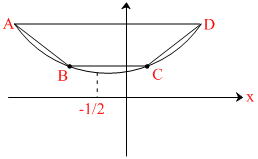
A(- 2, 3) ⇒ 3 = 4a - 2b + c
B(- 1, 1) ⇒ 1 = a - b + c
D(2, 7) ⇒ 7 = 4a + 2b + c
⇒ y = x2 + x + 1
C (h, h2 + h + 1), - 1 < h < 2
Area = 3/2 (- h2 + h + 6)
Maximum at h = 1/2 ⇒ C

Create a free account to view solution
View Solution FreeMore Application of Derivative Questions
Let f(x) = 40/(3x4 + 8x3 - 18x2 + 60). Which of the following statement(s) about f(x) is (are) correct ?...A tangent to the curve y = x2 + 3x passes through a point (0,− 9) if it is drawn at the point-...In which of the following intervals f(x) = 2x3 - 15x2 + 36x + 1 is monotonic decreasing -...The number of values of x, where the function f (x) = cos x + cos (√2x) attains its maximum, is...A cubic polynomial f(x) = ax3 + bx2 + cx + d has a graph which is tangent to the x-axis at 2, has another x-intercept at...