Application of DerivativeHard
Question
If p, q, r are any real numbers, then
Options
A.max (p,q) < max (p, q, r)
B.min (p,q) = {p + q - | p - q |}
{p + q - | p - q |}C.max (p,q) < min (p, q, r)
D.None of the above
Solution
Since, max (p, q)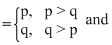
max (p, q, r)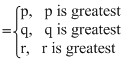
∴ max (p, q) < max (p, q, r) is false.
We know, |p - q|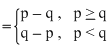
∴ {p + q - | p - q |}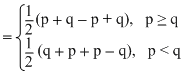

⇒ {p + q - | p - q |} = min (p, q)
max (p, q, r)
∴ max (p, q) < max (p, q, r) is false.
We know, |p - q|
∴
{p + q - | p - q |} ⇒
{p + q - | p - q |} = min (p, q)Create a free account to view solution
View Solution FreeMore Application of Derivative Questions
The normal to the curve √x + √y = √a is perpendicular to x-axis at the point-...The length of subnormal to the curve y2 = 12 ax at any point is-...The equation of one of the tangents to the curve y = cos (x + y), − 2π ≤ x ≤ 2π , that is pa...Let h(x) = f(x) - (f(x))2 + (f(x))3 for every real number x. Then...If the equation anxn + an-1xn-1 + .... + a1x = 0 has a positive root x = α, then the equation nanxn-1 + (n - 1) an-...