Application of DerivativeHard
Question
If f(x) =  ; g(x) =
  where 0 < x < 1, then
; g(x) = where 0 < x < 1, thenOptions
A.both ′f′ and ′g′ are increasing functions
B.′f′ is decreasing & ′g′ is increasing function
C.′f′ is increasing & ′g′ is decreasing function
D.both ′f′ & ′g′ are decreasing function
Solution
f(x) = 
f′(x) =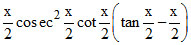
For 0 < x < 1, tan
⇒ f′ (x) > 0 ⇒ f(x) is increasing.
f′(x) =
For 0 < x < 1, tan
⇒ f′ (x) > 0 ⇒ f(x) is increasing.
Create a free account to view solution
View Solution FreeMore Application of Derivative Questions
If f(x) = xex(1-x), then f(x) is...The side of a square is increasing at the rate of 0.2 cm/sec, then the rate of increase of the perimetre of the square i...The slope of the tangent to the curve y = sin x at point (0, 0) is -...Let f(x) = (x − 4) (x − 5) (x − 6) (x − 7) then...The largest area of a rectangle which has one side on the x-axis and the two vertices on the curve y = e-x2 is...