Application of DerivativeHard
Question
Let f(x) = 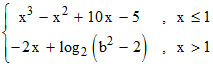 the set of values of b for which f(x) has greatest value at x = 1 is given by :
the set of values of b for which f(x) has greatest value at x = 1 is given by :Options
A.1 ≤ b ≤ 2
B.b = {1, 2}
C.b ∈ (- ∞, - 1)
D.
Solution
f(1-) ≤ f(1) and f(1+) ≤ f(1)
- 2 + log2 (b2 - 2) ≤ 5
0 < b2 - 2 ≤ 128 2 < b2 ≤ 130
- 2 + log2 (b2 - 2) ≤ 5
0 < b2 - 2 ≤ 128 2 < b2 ≤ 130
Create a free account to view solution
View Solution FreeMore Application of Derivative Questions
The equation of the normal to the curve 2y = 3 − x2 at (1, 1) is-...If tangent to a curve at a point is perpendicular to x-axis, then at that point-...Let f(x) = (x2 - 1)n (x2 + x + 1). f(x) has local extremum at x = 1 if...The slopes of the tangents to the curve y = (x + 1) (x − 3) at the points where it crosses x- axis are -...Let h(x) = f(x) - (f(x))2 + (f(x))3 for every real number x. Then...