Application of DerivativeHard
Question
If f(x) = a{a|x|sin x}; g(x) = a[a|x|sin x] for a > 1, a ≠ 1and x ∈ R, where { } & [ ] denote the fractional part and integral part functions respectively, then which of the following statements holds good for the function h(x), where (ln a) h(x) = (ln f(x) + ln g(x)).
Options
A.′h′ is even and increasing
B.′h′ is odd and decreasing
C.′h′ is even and decreasing
D.′h′ is odd and increasing
Solution
f(x) = a{a|x|sgn x}, g(x) = a[|x| sgn x]
for a > 1, a ≠ 1 and x ∈ R
ln a h(x) = ln f(x) + lng(x)
⇒ (ln a) h(x) ={a|x| sgnx} + lna + [a|x|sgnx]
⇒h(x) = a|x| sgn x
Now h(-x) = a|-x| sgn (-x) = -h(x)
h(x) is an odd function
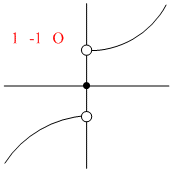
Also graph of h(x) is
It is clear from the graph that h(x) is an increasing function
Create a free account to view solution
View Solution FreeMore Application of Derivative Questions
If f(x) is differentiable in the interval [2, 5], where f(2) = and f(5) = , then there exists a number c, 2 < c < ...At what point the tangent to the curve √x + √y = √a is perpendicular to the x-axis-...The angle of intersection of the curves 2y = x3 and y2 = 32x at origin is -...The length of the tangent at any point to the curve x2/3 + y2/3 = a2/3 which is intercepted between the axes, is-...If f(x) = tan-1x - (1/2) ln x. Then...