Application of DerivativeHard
Question
If f(x) = tan-1x - (1/2) ln x. Then
Options
A.the greatest value of f(x) on [1/ √3, √3] is π/6 + (1/4) ln 3
B.the least value of f(x) on [1/ √3, √3] is π/3 - (1/4) ln 3
C.f(x) decreases on (0, ∞)
D.f(x) increases on (-∞, 0)
Solution
f′(x) =  , x > 0
= ≤ 0 ∀ x > 0
= f(x) is decreasing ∀ x > 0.
On , greatest value is
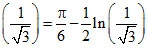 and least value is
f(√3) = ln√3
ln√3
, x > 0=
≤ 0 ∀ x > 0= f(x) is decreasing ∀ x > 0.
On
, greatest value is and least value isf(√3) =
ln√3Create a free account to view solution
View Solution FreeMore Application of Derivative Questions
The radius of a sphere is changing at the rate of 0. 1 cm/sec. The rate of change of its surface area when the radius is...y = x − 11 is a tangent to the curve y = x3 − 11 x + 5 at the point-...The length of the tangent to the curve x = a(θ + sin θ), y = a(1 - cos θ) at θ points is -...The equation of the tangents to the curve y = (x3 − 1) (x − 2) at the points where it meets x– axis are-...The length of subtangent at any point to the curve y = be−a/x is proportional to-...