Application of DerivativeMedium
Question
If f(x) 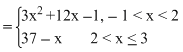 , then
, thenOptions
A.f(x) is increasing on [-1, 2]
B.f(x) is continuous on [-1,3]
C.f′(2) does not exist
D.f(x) has the maximum value at x = 2
Solution
For - 1 ≤ x ≤ 2 we have
f(x) = 3x2 + 12x - 1
⇒ f′(x) = 6x + 12 > 0, ∀ - 1 ≤ x ≤ 2
Hence, f(x) is increasing in [-1, 2]
A gain function is a algebraic polynomial, therefore, it is continuous at ∈ (-1, 2) and 2, 3) and continuity at x = 2
 f(x) (3x2 + 12x - 1)
 [3(2 - h)2 + 12(2 - h) - 1]
[3 (4 + h2 - 4h) + 24 - 12h - 1]
(12 + 3h2 - 12h + 24 - 12h - 1)
(3h2 - 24h + 35) = 35
and f(x) (37 - x)
[37 - (2 + h)] = 35
and f(2) = 3.22 +12.2 -1-12 + 24 -1 = 35
Therefoer, LHL = RHL = f(2) ⇒ function is continuous at x = 2 ⇒ function is continuous in - 1 ≤ x ≤3,
Now, Rf′(2)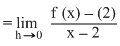
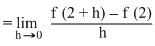
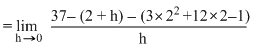
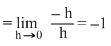
and Lf′(2)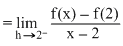
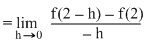
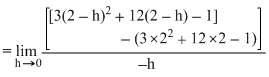

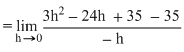
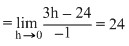
Since, Rf′(2) ≠ Lf′(2), fR
f(x) = 3x2 + 12x - 1
⇒ f′(x) = 6x + 12 > 0, ∀ - 1 ≤ x ≤ 2
Hence, f(x) is increasing in [-1, 2]
A gain function is a algebraic polynomial, therefore, it is continuous at ∈ (-1, 2) and 2, 3) and continuity at x = 2
f(x) (3x2 + 12x - 1) [3(2 - h)2 + 12(2 - h) - 1] [3 (4 + h2 - 4h) + 24 - 12h - 1] (12 + 3h2 - 12h + 24 - 12h - 1) (3h2 - 24h + 35) = 35and
f(x) (37 - x) [37 - (2 + h)] = 35 and f(2) = 3.22 +12.2 -1-12 + 24 -1 = 35
Therefoer, LHL = RHL = f(2) ⇒ function is continuous at x = 2 ⇒ function is continuous in - 1 ≤ x ≤3,
Now, Rf′(2)
and Lf′(2)
Since, Rf′(2) ≠ Lf′(2), fR
Create a free account to view solution
View Solution FreeMore Application of Derivative Questions
Consider the curve f(x) = x1/3, then -...Let a1, a2, a3 ...... and b1, b2, b3 ........ be arithmetic progression such that a1 = 25, b1 = 75 and a100 + b100 = 100...The equation of normal to the curve y2 = 16x at the point (1, 4) is-...An inverted cone has a depth of 10 cm and a base of radius 5 cm. Water is poured into it at the rate of 3/2 c.c. per min...If f(x) = (x - 4) (x - 5) (x - 6) (x - 7) then,...