Application of DerivativeEasy
Question
If a, b > 0 and ᐃ (x) =  , then -
, then -Options
A.ᐃ (x) is decreasing in (- )
)
)B.ᐃ(x) is increasing in ( , ∞)
, ∞)
, ∞)C.ᐃ(x) has a local minimum at x =
D.ᐃ(x) is strictly increasing.
Solution
Given that ᐃ(x) = 
now,
ᐃ′(w)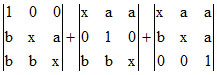
or ᐃ′(x) = 3(x2 - ab)
sign scheme for ᐃ′(x)
∴ ᐃ(x) is increasing in (- ∞, - ) ∪ (
) ∪ ( , ∞)
, ∞)
ᐃ(x) is decreasing in (- ).
).
ᐃ(x) has local minimum at x =
now,
ᐃ′(w)
or ᐃ′(x) = 3(x2 - ab)
sign scheme for ᐃ′(x)
∴ ᐃ(x) is increasing in (- ∞, -
) ∪ (, ∞)ᐃ(x) is decreasing in (-
).ᐃ(x) has local minimum at x =
Create a free account to view solution
View Solution FreeMore Application of Derivative Questions
If x = t2 and y = 2t, then equation of normal at t = 1 is-...The sum of the intercepts made by a tangent to the curve √x + √y = 4 at point (4, 4) on coordinate axes is-...The equation of normal to the curve y = ex at the point (0, 1) is-...The greatest, the least values of the function, f(x) = 2 - , x ∈ [- 2, 1] are respectively...The rate of change of the volume of a cone with respect to the radius of its base is-...