Application of DerivativeVery Hard
Question
The function f(x) =  t(et - 1)(t - 1)(t - 2)3(t - 3)5dt minimum at x equals to
t(et - 1)(t - 1)(t - 2)3(t - 3)5dt minimum at x equals toOptions
A.0
B.1
C.2
D.3
Solution
f(x) =  t(et - 1)(t - 1)(t - 2)3(t - 3)5dt
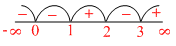
f′(x) t(et - 1)(t - 1)(t - 2)3(t - 3)5dt
= x(ex -1)(x -1)(x - 2)3 (x - 3)5 × 1

For local minimum, f′(x) = 0
⇒ x = 0,1, 2,3.
Let f′(x) = g(x) = x(ex - 1)(x - 1)(x - 2)3 (x - 3)5
Using sign scheme rule,
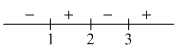
This shows that f(x) has a local minimum at x = 1 and x = 3 and maximum at x = 2
Therefore, (b) and (d) are the correct answer.
t(et - 1)(t - 1)(t - 2)3(t - 3)5dt f′(x)
t(et - 1)(t - 1)(t - 2)3(t - 3)5dt = x(ex -1)(x -1)(x - 2)3 (x - 3)5 × 1
For local minimum, f′(x) = 0
⇒ x = 0,1, 2,3.
Let f′(x) = g(x) = x(ex - 1)(x - 1)(x - 2)3 (x - 3)5
Using sign scheme rule,
This shows that f(x) has a local minimum at x = 1 and x = 3 and maximum at x = 2
Therefore, (b) and (d) are the correct answer.
Create a free account to view solution
View Solution FreeMore Application of Derivative Questions
The points on the curve 9y2 = x3 where the normal to the curve cuts equal intercepts from the axes are-...Point on the curve y2 = x - 2, the normal at which is also the normal to the curve x2 = y - 2...At any point of a curve is equal to -...The equation of tangent to the curve y = 1 - ex/2 at the point where it meets y-axis is-...If a, b, c are positive numbers in G.P. and log , log and log are in A.P., then a, b, c forms the sides of a triangle wh...