Application of DerivativeMedium
Question
The normal to the curve x = a (cos θ + θ sin θ) y = a (sin θ - θ cos θ) any point ′θ′ is such that
Options
A.it makes a constant angle with the x-axis
B.it passes through the origin
C.it is at a constant distance from the origin
D.None of the above
Solution
Given, x = a (cos θ + θ sin θ)
and y = a (sin θ - θ cos θ)
∴ = a(- sin θ + sin θ + θ cos θ)
= a = θ cos θ
and = a (cos θ - cos θ + θ sin θ)
= a θ sin θ ⇒  = tan θ
Thus, equation of normal is
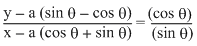
⇒ - x cos θ + aθ sinθ cosθ + α cos2θ
= y sinθ + aθ sinθcosθ + αcos2 θ
⇒ = x cos θ + y sin θ = a
whose distance from origin is,
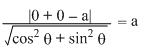
and y = a (sin θ - θ cos θ)
∴
= a(- sin θ + sin θ + θ cos θ) = a = θ cos θ
and
= a (cos θ - cos θ + θ sin θ) = a θ sin θ ⇒ = tan θ Thus, equation of normal is
⇒ - x cos θ + aθ sinθ cosθ + α cos2θ
= y sinθ + aθ sinθcosθ + αcos2 θ
⇒ = x cos θ + y sin θ = a
whose distance from origin is,
Create a free account to view solution
View Solution FreeMore Application of Derivative Questions
If the tangents at any point on the curve x4 + y4 = a4 cuts off intercept p and q on the axes, the value of p−4/3 ...If = 0, where C0 C1 C2 are all real, then the quadratic equation C2x2 + C1x + C0 = 0 has...A tangent to the curve y = x2 + 3x passes through a point (0, -9) if it is drawn at the point-...The slope of the normal to the curve x = a (θ - sinθ), y = a(1 - cosθ) at point θ = π/2 is -...The angle of intersection between curves y = x3 and 6y = 7 - x2 at point (1, 1) is-...