Application of DerivativeMedium
Question
Let h(x) = f(x) - (f(x))2 + (f(x))3 for every real number x. Then
Options
A.h is increasing whenever f is increasing
B.h is increasing whenever f is decreasing
C.h is decreasing whenever f is decreasing
D.nothing can said in general
Solution
Given h(x) = f(x) - (f(x))2 + (f(x))3
On differentiating w. r. t. x, we get
h′(x) = f′(x) - 2 f(x). f′(x) + 3 f2(x). f′(x)
= f′(x)[1- 2 f(x) + 3 f2(x)]
= 3f′(x)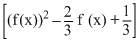
= 3f′(x)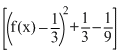
= 3f′(x)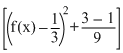
= 3f′(x)
Note that h′(x) < 0 if f′(x) < 0 and h′(x) > 0 and f′(x) > 0
Therefore, h(x) is increasing function if f (x) is increasing function, and h(x) is decreasing function if f(x) is decreasing function.
Therefore, options (a) and (c) are correct answers.
On differentiating w. r. t. x, we get
h′(x) = f′(x) - 2 f(x). f′(x) + 3 f2(x). f′(x)
= f′(x)[1- 2 f(x) + 3 f2(x)]
= 3f′(x)
= 3f′(x)
= 3f′(x)
= 3f′(x)
Note that h′(x) < 0 if f′(x) < 0 and h′(x) > 0 and f′(x) > 0
Therefore, h(x) is increasing function if f (x) is increasing function, and h(x) is decreasing function if f(x) is decreasing function.
Therefore, options (a) and (c) are correct answers.
Create a free account to view solution
View Solution FreeMore Application of Derivative Questions
For the A.P. given by a1, a2,........an,....... with non-zero common difference, the equations satisfied are-...The length of subtangent to the curve x2 + xy + y2 = 7 at the point (1, − 3) is-...The equation of normal to the curve y = tan x at the point (0, 0) is-...The point where the tangent line to the curve y = e2x at (0, 1) meets x-axis is -...The coordinates of the point on the curve y = x2 + 3x + 4, the tangent at which passes through the origin are-...