Continuity and DifferentiabilityHard
Question
If y2 = p(x) is a polynomial of degree 3, then  equals
equalsOptions
A.p′′′(x) + p′(x)
B.p′′(x) . p′′′(x)
C.p′(x) p′′′(x)
D.a contstant
Solution
Since, y2 = p(x)
On differentiating both sides, we get
2yy = P′(x)
Again, differentiating both sides, we get
2yy2 + 2y12 = p′′(x)
⇒ 2y3y2 + 2y2y12 = y2 p′′(x)
⇒ 2y3y2 = y2 p′′(x) - 2(yy1)2
⇒ 2y3y2 = p(x).p′′(x)
Again, differentiating, we get
 (y3y2) = p′(x).p′′(x) + p(x) . p′′′(x)
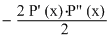
⇒ (y3y2) = p(x). p′′(x)
⇒ = p(x). p′′(x)
On differentiating both sides, we get
2yy = P′(x)
Again, differentiating both sides, we get
2yy2 + 2y12 = p′′(x)
⇒ 2y3y2 + 2y2y12 = y2 p′′(x)
⇒ 2y3y2 = y2 p′′(x) - 2(yy1)2
⇒ 2y3y2 = p(x).p′′(x)
Again, differentiating, we get
(y3y2) = p′(x).p′′(x) + p(x) . p′′′(x) ⇒
(y3y2) = p(x). p′′(x)⇒
= p(x). p′′(x)Create a free account to view solution
View Solution FreeMore Continuity and Differentiability Questions
The function f(x) = [x]2 -[x2] (where [x] is the greatest integer less than or equal to x), is discontinuous at...The value(s) of x for which f(x) = is continuous, is (are) -...If y = xx + ax + xa, then at x = 1 equals-...If , then xy2 + y1 − y is equals to -...If y = x3 log x, then the value of is-...