Continuity and DifferentiabilityHard
Question
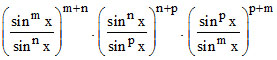
If f(x) =
then f′(x) is equal to-
Options
A.0
B.1
C.cosm+n+px
D.None of these
Solution
f(x) = (sin x)m2 - n2 . (sin x)n2 - p2 . (sin x)p2 - m2
f(x) = (sin x)m2 - n2 + n2 - p2 + p2 - m2
f(x) = (sin x)0 = 1
f′(x) = 0
f(x) = (sin x)m2 - n2 + n2 - p2 + p2 - m2
f(x) = (sin x)0 = 1
f′(x) = 0
Create a free account to view solution
View Solution FreeMore Continuity and Differentiability Questions
If f(x) = ,x ≠ 0 is continuous at x = 0, then -where [x] and {x} denotes greatest integer and fractional part func...Which one of the following functions is continuous everywhere in its domain but has at least one point where it is not d...If + = c, then is equal to -...If y = f(x) is an odd differentiable function defined on (-∞, ∞) such tha f′(3) = -2, then f′(-3...Given f(x) = where { } & [ ] denotes the fractional part and the integral part functions respectively, then which of the...