DeterminantMedium
Question
The number of distinct real roots of 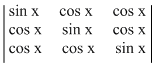 = 0 in the interval -
  ≤ x ≤ is
= 0 in the interval - ≤ x ≤ is Options
A.0
B.2
C.1
D.3
Solution
Given, 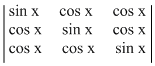 = 0
= 0
Applying C1 → C1 + C2 + C3
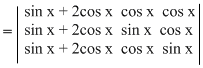
= (cos x + sin x)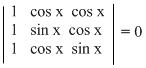
Applying R2 → R2 - R1, R3 → R3 - R1
⇒ (2 cos x + sin x)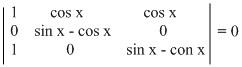
⇒ (2cos x + sin x)(sin x - cos x)2 = 0
⇒ 2 cos x + sin x = 0 or sin x - cos x = 0
⇒ 2 cos x = - sin x or sin x = cos x
⇒ cot x = - 1/2 gives no solution in - ≤ x ≤
≤ x ≤
and sin x = cos x ⇒ tan x = 1
⇒ x = π / 4
= 0Applying C1 → C1 + C2 + C3
= (cos x + sin x)
Applying R2 → R2 - R1, R3 → R3 - R1
⇒ (2 cos x + sin x)
⇒ (2cos x + sin x)(sin x - cos x)2 = 0
⇒ 2 cos x + sin x = 0 or sin x - cos x = 0
⇒ 2 cos x = - sin x or sin x = cos x
⇒ cot x = - 1/2 gives no solution in -
≤ x ≤ and sin x = cos x ⇒ tan x = 1
⇒ x = π / 4
Create a free account to view solution
View Solution FreeMore Determinant Questions
Value of the ᐃ = is...If = k , then k is equal to -...The system of linear equations x + y + z = 2, 2x + y − z = 3, 3x + 2y + kz = 4 has a unique solution if-...If A and B are two matrices, then...Let $\alpha,\beta \in \mathbf{R}$ be such that the system of linear equations$$x + 2y + z = 5 $$$$2x + y + \alpha z = 5 ...