Quadratic EquationHard
Question
If the roots of the equation x2 - 2ax + a2 + a - 3 = 0 are real and less than 3, then
Options
A.
- 4 < a < 2
- 4 < a < 2
B.2 ≤ a ≤ 3
C.3 ≤ a ≤ 4
D.a > 4
Solution
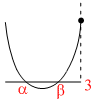
Let f (x) = x2 - 2ax = a2 + a - 3
Since, both root are less than 3.
⇒ α < 3, β < 3
⇒ Sum, S = α + β < 6
⇒
 < 3
⇒
 < 3
⇒ α < 3 .......(i)
Again, product, P = αβ
⇒ P < 9
⇒ αβ < 9
⇒ α2 + a - 3 < 9
⇒ α2 + a - 12 < 0
⇒ (α - 3)(a + 4) < 0
⇒ -4 < a < 3 .......(ii) Agani, D = B2 - 4AC ≥ 0
⇒ (-2a)2 - 4.1 (a2 + a - 3) ≥ 0
⇒ 4a2 - 4a2 - 4a + 12 ≥ 0
⇒ - 4a + 12 ≥ 0
⇒ a ≤ 3 .......(iii)
Agani, a f (3) > 0
⇒ 1[(3)2 - 2a(3) + a2 + a - 3] > 0
⇒ 9 - 6a + a2 + a - 3 > 0
⇒ a2 - 5a + 6 > 0
⇒ (a - 2)(a - 3) > 0
∴ a ∈ ( - ∞, 2)
 (3, ∞) .......(iv)
From Eqs. (i),(ii),(iii) and (iv), we get
a ∈ (-4, 2)
Thereform, (a) is the answer.
Create a free account to view solution
View Solution FreeMore Quadratic Equation Questions
The roots of the equation (p − 2) x2 + 2 (p − 2) x + 2 = 0 are not real when -...Difference between the corresponding roots of x2 + ax + b = 0 and x2 + bx + a = 0 is same and a × b, then...If the roots of the equation are equal in magnitude but opposite in sign, then their product is -...If x = then -...The largest interval for which x12 - x9 + x4 - x +1 > 0 is...