Quadratic EquationMedium
Question
Let a > 0, b > 0 and c > 0. Then, both the roots of the equation ax2 + bx + c = 0.
Options
A.are real and negative
B.have negative real parts
C.have positive real parts
D.None of the above
Solution
Since, a, b, c > 0
and az2 + bx + c = 0
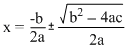
⇒
Case I When b2 - 4ac > 0
⇒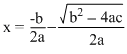 and
and 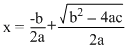 both roots, are negative.
Case II When b2 - 4ac < 0
⇒ ie, both toots are equal and negative
Case III When b2 - 4ac < 0
⇒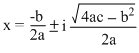 have negative real part.
∴ From sbove discussion both roots have negative real parts.
and az2 + bx + c = 0
⇒
Case I When b2 - 4ac > 0
⇒
and both roots, are negative.Case II When b2 - 4ac < 0
⇒
ie, both toots are equal and negative Case III When b2 - 4ac < 0
⇒
have negative real part. ∴ From sbove discussion both roots have negative real parts.
Create a free account to view solution
View Solution FreeMore Quadratic Equation Questions
If α, β are the roots of ax2 + bx + c = 0 and α + h, β + h are the roots of px2 + qx + r = 0, then h...The set of all real numbers x for which x2 - |x + 2| + x > 0 is...Difference between the corresponding roots of x2 + ax + b = 0 and x2 + bx + a = 0 is same and a × b, then...The number of quadratic equations which are unchanged by squaring their roots are -...If roots of the equation ax2 + 2 (a + b) x + (a + 2b + c) = 0 are imaginary, then roots of the equation ax2 + 2bx + c = ...