ElectrostaticsEasy
Question
A positively charged thin metal ring of radius R is fixed in the x-y plane with its centre at the origin. A negatively charged particle P is released from the rest at the point (0, 0 z0) where z0 > 0. Then the motion of P is
Options
A.periodic for all values of z0 satisfying 0 < z0 < ∞
B.simple harmonic for all values of z0 satisfying 0 < z0 ≤ R
C.approximately simple harmonic provoded z0 << R
D.such that P crosses O and continues to move along the negative z-axis towards z = - ∞
Solution
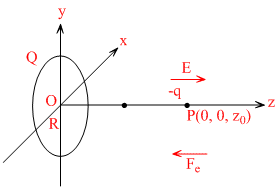
Let Q be the charge on the ring, the negative charge - q is released from point P(0,0,z0).
The electric field at P due to the charged ring will be along positive z-axis and its magnitude will be
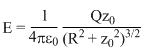
E = 0 at centre of the ring because z0 = 0
Forece on charge at P will be towards centre as shown, and its magnitude is
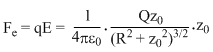 ......(i)
Similarly, when it crosses the origin, the force ia again towards centre O.
Thus, the motion of the particle is periodic for all values of z0 lying between 0 and ∞
Secondly, if z0 << R, (R2 + z02)3/2
 R3
R3 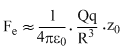 [From Eq. (i)]
 i.e., the restoring force Fe ∝ - z0. Hence, the motion of the particle will be simple harmonic. (Here negative sign implies that the force is towards its mean position.)
Create a free account to view solution
View Solution FreeMore Electrostatics Questions
A spherical portion has been removed from a solid sphere having a charge distributed uniformly in its volume as shown in...Two short electric dipoles are placed as shown. The energy of electric interaction between these dipoles will be...Three equal charges of charge 10μ C are placed at vertices of equilateral triangle of side 10 cm. Electric potentia...An elliptical cavity is carved within a perfect conductor. A positive charge q is placed at the centre of the cavity. Th...When an electric dipole is kept in a uniform electric field then for what value of the angle between and,torque will be ...