ElectrostaticsEasy
Question
Two point charges +q and q are held fixed at (d, 0) and (d, 0) respectively of x-y co-ordinate system. Then
Options
A.the elctric field E at all points on the x-axis has the same directions
B.work has to be done in bringing a test charge from ∞ to the origin
C.electric field at all point on y-axis is along x-axis
D.the dipole moment is 2qd along the x-axis
Solution
The diagramatic representation of the given question is shown in the figure
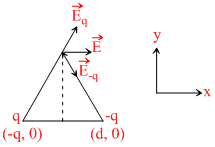
The electric field at all points on the x-axis will not have the same directions.
For - d ≤ x ≤ d, electric field is along positive x-axis while for all other points it is along negative x-axis.
The electric field at all points on the y-axis will be parallel to the x-axis (i.e.,  ) [option (c)]
The electrical potential at the origin due to both the charges is zero, hence no work is done in bringing a test charge from infinity to the origin
Dipole moment is directed from the -q charge to the +q charge (i.e., direction).
The electric field
at all points on the x-axis will not have the same directions. For - d ≤ x ≤ d, electric field is along positive x-axis while for all other points it is along negative x-axis.
The electric field
at all points on the y-axis will be parallel to the x-axis (i.e., ) [option (c)]The electrical potential at the origin due to both the charges is zero, hence no work is done in bringing a test charge from infinity to the origin
Dipole moment is directed from the -q charge to the +q charge (i.e.,
direction).Create a free account to view solution
View Solution FreeMore Electrostatics Questions
Two-point charges of 1 nC and 2 nC are placed at the two corners of equilateral triangle of side 3 cm . The work done in...At a certain distance from a point charge, the electric field is 500 V/m and the potential is 3000 V. What is the distan...The electric field at a point distance r on the dipole axis is given by -...Five balls numbered 1 to 5 are suspended using separate threads. Pairs (1,2); (2,4) and (4,1) show electrostatic attract...A charge Q is divided in two parts Q1 and Q2 and these charges are placed at a distance R. There will be maximum repulsi...