Geometrical OpticsEasy
Question
Two thin convex lenses of focal lengths f1 and f2 are separately by a horizontal distance d (where d < f1, d < 2) and their centers are displaced by a vertical sepration ᐃ as shown in the figure
Taking the origin of coordinates, O, at the centre of the first lense, x and y -coordinates of the focal point of this lense system, for a parallel beam of rays coming from the left, are given by
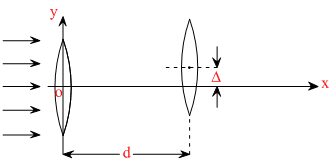
Taking the origin of coordinates, O, at the centre of the first lense, x and y -coordinates of the focal point of this lense system, for a parallel beam of rays coming from the left, are given by
Options
A. , y = ᐃ
, y = ᐃB.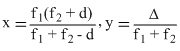
C.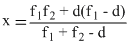 , y =
, y = 
, y = D.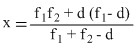 , y = 0
, y = 0Solution
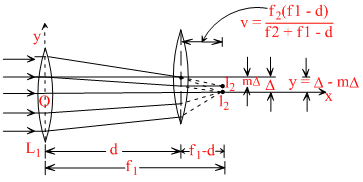
From the first lens parallel beam of light is focused at its focus i.e., at a distance f1 from it. The image I1 acts as virtual object for scrond lens L2, Therefore, for L2
u = + (f1 - d), f = + f2
∴
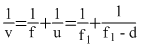
Hence,

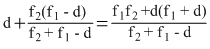
Therefore, x-coordinates of its focal point will be
x = d + v =
Linear magnification for L2
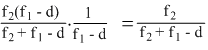
Therefore, second image will be formed at a distance of mᐃ or
 . ᐃ below its optics axis.
Therefore, y-coordinates of the focus of the system will be
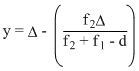 or
or 
Create a free account to view solution
View Solution FreeMore Geometrical Optics Questions
A ray is incident at 30o angle on plane mirror. What will be deviation after reflection from mirror....The graph between angle of deviation (δ) and angle of incidence (i) for a triangular prism is represented by :-...The focal length of a concave mirror is 12 cm. Where should an object of length 4 cm be placed, so that a real image of ......Optic axis of a equiconvex lens is the x - axis. The coordinates of a point object and its image are (-40 cm, 1cm) and (...