SHMEasy
Question
A particle free to move along the x-axis has potential energy given by
U(x) = k[1 - exp( - x2)] for - ∞ ≤ x ≤ + ∞ , where k is a positive constant of appropriate dimensions. Then
U(x) = k[1 - exp( - x2)] for - ∞ ≤ x ≤ + ∞ , where k is a positive constant of appropriate dimensions. Then
Options
A.at points away from the origin, the particle is in unstable equilibrium
B.for any finite non-zero value of x, there is a force directed away from the origin
C.if its total mechanical energy is k/2, it has its minimum kinetic energy at the origin
D.for small displacements from x = 0, the motion is simple harmonic.
Solution
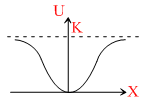
U(x) = k(1 - e-x2)
It is an exponentially increasing graph of potential energy (U) with x2. Therefore, U versus x graph will be as shown. At origin.
Potential energy U is minimum (therefore, kinetic energy will be maimum) and force acting on the particle is zero because
F =
 = - (slope of U - x graph) = 0
Therefore, origin is the stable equilibrium position. Hence particle will oscillate simple harmonically about x = 0 for small place displacement. Therefore, correct option is (d). (a), (b) and (c) options are wrong due to following reasions.
(a) At equilibrium position F =
= 0 i.e., slope of U-x graph should be zero and from the grapgh we can see that slope is zero at x = 0 and x =  ∞
∞ Now among these equlibriums stable equlibrium positions is that where U is minimum (Here x = 0). Unstable equlibrium position is that where U is maximum (here none).
Neutral equlibrium position is that where U is constant (Here x =
∞) Therefore, option (a) is wrong
(b) For any finite non-zero value of x, force is directed towards the origin because origin is an stable equilibrium position. Therefore option (b) is incorrect.
(c) At origin, potential energy is minimum, hence kinetic energy will be maximum.
Therefore, option (c) is wrong.
Create a free account to view solution
View Solution FreeMore SHM Questions
The value of phase at maximum distance from the mean position of a particle in S.H.M. is :...Block A in the figure is released from rest when the extension in the spring is x0. The maximum downward displacement of...The mass of a bob, suspended in a simple pendulum, is halved from the initial mass, its time period will :...A simple pendulum of length 1 m is allowed to oscillated with amplitude 2o. It collides elastically with a wall inclined...A simple harmonic oscillator has a period of 0.01 sec. and an amplitude of 0.2 m. The magnitude of the velocity in m sec...