KinematicsEasy
Question
The coordinate of a particle moving in a plane are given by x (t) = a cos ( pt) and y (t) = bsin ( pt) , where a, b (< a) and p are positive onstants of appropriate dimensions. Then
Options
A.the path of the particle is an ellipse
B.the velocity and acceleration of the particle are normal to each other at t = π/2p
C.the acceleration of the particle is always directed towards a focus
D.the distance travelled by the particle in time interval t = 0 to t = π/2p is a.
Solution
x = a cos ( pt) ⇒ cos(pt) =  ......(i)
y = b sin ( pt) ⇒ sin (pt) = ......(ii)
Squaring and adding Eqs. (i) and (ii), we get
 = 1
= 1
Therefore, path of the particle is an ellipse. Hence option (a) is correct.From the given equation we can find
 = vx = - ap sin pt
 = ax = - a2 cos pt
 = vy = bp cos pt and
 ay = - bp2 sin pt
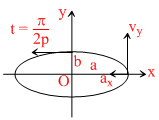
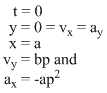
At time t = π/2p or pt = π/2
ax and vy become zero (because cos π/2 = 0)
only vx and ay are left.
or we can sat that velocity is along negative x-axis and acceleration along y-axis
Hence, at t = π/2p velocity and acceleration of the particle are normal to each other. So option (b) is also correct.
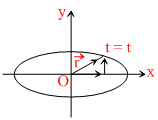
At t = t, position of the particle

and acceleration of the particle is
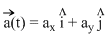
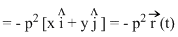
Therefore, acceleration of the particle is always directed towards origin.
Hence, option (c) is also corrent.
At t = 0 particle is at (a, 0) and t = π/2p particle is at (0, b). Therefore, the distance covered is one-fouth of the
......(i)y = b sin ( pt) ⇒ sin (pt) =
......(ii)Squaring and adding Eqs. (i) and (ii), we get
= 1Therefore, path of the particle is an ellipse. Hence option (a) is correct.From the given equation we can find
= vx = - ap sin pt = ax = - a2 cos pt = vy = bp cos pt and ay = - bp2 sin pt At time t = π/2p or pt = π/2
ax and vy become zero (because cos π/2 = 0)
only vx and ay are left.
or we can sat that velocity is along negative x-axis and acceleration along y-axis
Hence, at t = π/2p velocity and acceleration of the particle are normal to each other. So option (b) is also correct.
At t = t, position of the particle
and acceleration of the particle is
Therefore, acceleration of the particle is always directed towards origin.
Hence, option (c) is also corrent.
At t = 0 particle is at (a, 0) and t = π/2p particle is at (0, b). Therefore, the distance covered is one-fouth of the
Create a free account to view solution
View Solution FreeMore Kinematics Questions
From a building two balls A and B are thrown such that A is thrown upward and B downwards (both vertically). If vA and v...The velocity of a particle projected from the ground with initial velocity u, making angle q with the horizontal after t...A projectile is thrown upward at an angle $60^{\circ}$ with the horizontal. The speed of the projectile is $20\text{ }m/...The total speed of a projectile at its greatest is of its speed when it is half of its greatest height. The angle of pro...A, B, C and are points in a vertical line such that AB = AC = CD. If a body falls from rest A, then the times of descend...