Errors in measurementMedium
Question
A student measure the distance traversed in free of a body, Initially at rest, in a given time. He uses this data to estimate g, the acceleration due to gravity. If the maximum percentage errors in measurement of the distance and time are e1 and e2 respectively, the percentage error in estimation of g is
Options
A.e2 - e1
B.e1 + 2e2
C.e1 + e2
D.e1 - 2e2
Solution
From the relation
h = ut + gt2
h =gt2 ⇒ g =  (∵ body initially at rest)
Taking natural logarithm on both sides, we get
ln g = ln h - 2ln t
Differentiating,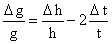
For maximum permissible error,
or
According to problem
 × 100 = e1 and
 × 100 = e2
Therefore, = e1 + 2e2
h = ut +
gt2h =
gt2 ⇒ g = (∵ body initially at rest)Taking natural logarithm on both sides, we get
ln g = ln h - 2ln t
Differentiating,
For maximum permissible error,
or
According to problem
× 100 = e1 and × 100 = e2 Therefore,
= e1 + 2e2 Create a free account to view solution
View Solution FreeMore Errors in measurement Questions
A vernier calipers having 1 main scale division = 0.1 cm is designed to have to have a least count of 0.02 cm. If n be t...The length of a cylinder is measured with a meter rod having least count 0.1 cm. Its diameter is measured with vernier c...The length, breath and thickness of a strip (10.0 ± 0.1) cm, (1.00 ± 0.01) cm a (0.100 ± 0.001) cm respec...If the percentage error in the measurement of radius of a sphere is 2%, then the maximum percentage errors in the measur...A student measured the diameter of a small steel ball using a screw gauge of least count 0.001 cm. The main scale readin...