Chemical Kinetics and Nuclear ChemistryMedium
Question
During the kinetic study of the reaction, 2A + B → C + D, following results were obtained
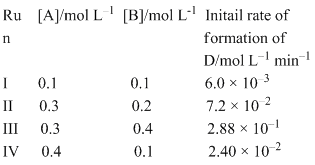
Based on the above data which one of the following is correct ?
Based on the above data which one of the following is correct ?
Options
A.rate = k [A]2[B]
B.rate = k [A] [B]
C.rate = k [A]2[B]2
D.rate = k [A] [B]2
Solution
Let the order of reaction with respect to A is x and with respect to B is y. Thus,
rate = k [A]x [B]y
For the given cases,
(i) rate = k (0.1)x (0.1)y = 6.0 × 10⁻³
(ii) rate = k (0.3)x (0.2)y = 7.2 × 10⁻²
(iii) rate = k (0.3)x (0.40)y = 2.88 × 10⁻¹
(iv) rate = k (0.4)x (0.1)y = 2.40 ×10⁻²
On dividing eq. (i) by (iv), we get
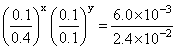
or
∴ x = 1
On dividing Eq. (ii) by (iii), we get
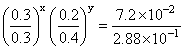
or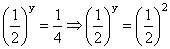
∴ y = 2
Thus, rate law is,
rate = k [A]1 [B]2 or
= k [A] [B]2
rate = k [A]x [B]y
For the given cases,
(i) rate = k (0.1)x (0.1)y = 6.0 × 10⁻³
(ii) rate = k (0.3)x (0.2)y = 7.2 × 10⁻²
(iii) rate = k (0.3)x (0.40)y = 2.88 × 10⁻¹
(iv) rate = k (0.4)x (0.1)y = 2.40 ×10⁻²
On dividing eq. (i) by (iv), we get
or
∴ x = 1
On dividing Eq. (ii) by (iii), we get
or
∴ y = 2
Thus, rate law is,
rate = k [A]1 [B]2 or
= k [A] [B]2
Create a free account to view solution
View Solution FreeTopic: Chemical Kinetics and Nuclear Chemistry·Practice all Chemical Kinetics and Nuclear Chemistry questions
More Chemical Kinetics and Nuclear Chemistry Questions
Which one of the following statements for order of a reaction is not correct?...The colligative property is not represented by :...Select the correct statements out of I, II and III for zero order reactionI : Quantity of the product formed is directly...The activation energy of a reaction is zero. The rate constant of the reaction...The rate constant k, for the reaction N2O5(g) → 2NO2(g) + O2(g) is 1.3 × 10⁻²s-1. Which equation given below ...