Properties of TriangleEasy
Question
Let ABC be a triangle such that ∠ACB =  and let a, b and c denote the lengths of the sides opposite to A,B and C respectively. The value(s) of x for which a = x2 + x + 1, b = x2 - 1 and c = 2x + 1 is (are)
and let a, b and c denote the lengths of the sides opposite to A,B and C respectively. The value(s) of x for which a = x2 + x + 1, b = x2 - 1 and c = 2x + 1 is (are)Options
A.−(2 + √3)
B.1 + √3
C.2 + √3
D.4√3
Solution
Using cosine rule for ∠C

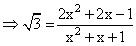
⇒ (√3 - 2)x2 + (√3 - 2)x + (√3 +1) = 0
⇒ x =
⇒ x = - (2 + √3), 1 + √3 ⇒ x = 1 + √3 as (x > 0).
⇒ (√3 - 2)x2 + (√3 - 2)x + (√3 +1) = 0
⇒ x =
⇒ x = - (2 + √3), 1 + √3 ⇒ x = 1 + √3 as (x > 0).
Create a free account to view solution
View Solution FreeMore Properties of Triangle Questions
Let a, b, c be the sides of a triangle. No two of them are equal and λ ∈ R. If the roots of the equation x2 +...Let PS be the median of the triangle with vertices P(2, 2), Q(6, - 1) and R (7, 3). The equation of the line passing thr...In a ᐃABC, 2R2 sinA sinB sinC =...In a triangle ABC, is equal to -...In a ᐃABC, (b + c − a) tan is equals to -...