DeterminantHard
Question
If a, b, and c, nonzero real numbers, then
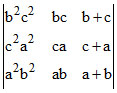
is equal to -
Options
A.a2b2c2(a + b + c)
B.abc(a + b + c)2
C.zero
D.non of these
Solution
D = 
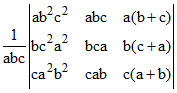
(R1 → aR1, R2 → bR2, R3 → cR3)
= abc
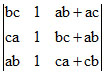
= abc (ab + bc + ca)
(C1 → C3 + C1)
= 0
(R1 → aR1, R2 → bR2, R3 → cR3)
= abc
= abc (ab + bc + ca)
(C1 → C3 + C1)
= 0
Create a free account to view solution
View Solution FreeMore Determinant Questions
The least value of the product xyz for which the determinant is non-negative is :...If the determinant splits into exactly K determinants of order 3, each element of which contains only one term, then the...The number of distinct real roots of = 0 in the interval - ≤ x ≤ is...If A is a square matrix of order 3, then the true statement is (where I is unit matrix)....The system of linear equations$${x + y + z = 6 }{2x + 5y + az = 36 }{x + 2y + 3z = b }$$has...