Application of DerivativeHard
Question
If the (m + 1)th . (n + 1)th & (r + 1)th terms of an AP are in GP & m, n, r are in HP, then the ratio of the common difference to the first term of the AP is -
Options
A.
B.
C.
D.none of these
Solution
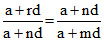
⇒ 
⇒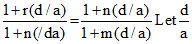 = x
= x
⇒ (1 + nx)2 = (1 + rx) (1 + mx)
⇒ (n2 - mr)x2 + (2n - r - m)x = 0 ⇒ x = 0
or x =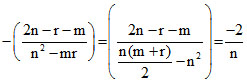
(m, n, r are in H.P. ⇒ mr = )
)
⇒
= x⇒ (1 + nx)2 = (1 + rx) (1 + mx)
⇒ (n2 - mr)x2 + (2n - r - m)x = 0 ⇒ x = 0
or x =
(m, n, r are in H.P. ⇒ mr =
)Create a free account to view solution
View Solution FreeMore Application of Derivative Questions
If length of subnormal at any point of the curve yn = an-1x is constant, then n equals-If length of subnormal at any poi...If x1 and x2 are abscissa of two points on the curve f(x) = x - x2 in the interval [0, 1], then maximum value of the exp...Let f be a function which is continuous and differentiable for all real x. If f(2) = -4 and f′(x) ≥ 6 for al...If f(x) = ,x ∈ , then...The point where the tangent line to the curve y = e2x at (0, 1) meets x-axis is -...