Application of DerivativeHard
Question
If f(x) and g(x)
 , where 0 < x ≤ 1 then in this interval
and g(x), where 0 < x ≤ 1 then in this interval Options
A.both f(x) and g(x) are increasing functions
B.both f(x) and g(x) are decreasing functions
C.f(x) is an increasing functions
D.g(x) is an increasing functions
Solution
Let g(x)  , if 0 < x ≤ 1
Now, g(x) is continuous on [0, 1] and differentiable on ]0,1[
For 0 < x < 1
g′(x)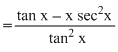
Again, H(x) = tan x - x sec2 x, 0 ≤ x ≤ 1
Now, H(x) is continuous on [0, 1] and differentiable on ]0,1[.
For 0 < x <1
H(x) = tan x - x sec2 x,0 ≤ x ≤ 1
⇒ H′(x) = sec2 x - sec2 x - 2x sec2 x tan x
= - 2x sec2 x tan x < 0
∴ H(x) is decreasing function on [0, 1]. Thus
H(x) < H (0) for 0 < x < 1
⇒ H(x) < 0 for 0 < x <1
⇒ g′(x) < 0 for 0 < x < 1
⇒ g(x) is decreasing function on [0, 1 ].
Therefore, g(x) = is a decreasing function on 0 < x ≤ 1
Also, g(x) < g(0) for 0 < x ≤ 1
⇒ < 1 for o < x ≤ 1
⇒ x < tan x fopr 0 < x ≤ 1
Next, let f(x)
Now, f is continuous on [0, 1] and differentiable on ]0, 1[.
For 0 < x ≤ 1
f′(x)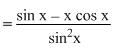
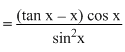 > 0 for o < x < 1
⇒ f(x) increases on [0, 1].
Thus, f(x) increases on 0 < x ≤ 1
Therefore, (c) is the answer.
, if 0 < x ≤ 1 Now, g(x) is continuous on [0, 1] and differentiable on ]0,1[
For 0 < x < 1
g′(x)
Again, H(x) = tan x - x sec2 x, 0 ≤ x ≤ 1
Now, H(x) is continuous on [0, 1] and differentiable on ]0,1[.
For 0 < x <1
H(x) = tan x - x sec2 x,0 ≤ x ≤ 1
⇒ H′(x) = sec2 x - sec2 x - 2x sec2 x tan x
= - 2x sec2 x tan x < 0
∴ H(x) is decreasing function on [0, 1]. Thus
H(x) < H (0) for 0 < x < 1
⇒ H(x) < 0 for 0 < x <1
⇒ g′(x) < 0 for 0 < x < 1
⇒ g(x) is decreasing function on [0, 1 ].
Therefore, g(x) =
is a decreasing function on 0 < x ≤ 1Also, g(x) < g(0) for 0 < x ≤ 1
⇒
< 1 for o < x ≤ 1 ⇒ x < tan x fopr 0 < x ≤ 1
Next, let f(x)
Now, f is continuous on [0, 1] and differentiable on ]0, 1[.
For 0 < x ≤ 1
f′(x)
> 0 for o < x < 1 ⇒ f(x) increases on [0, 1].
Thus, f(x)
increases on 0 < x ≤ 1 Therefore, (c) is the answer.
Create a free account to view solution
View Solution FreeMore Application of Derivative Questions
The rate of change of the area of a circular disc with respect to its circumference when the radius is 3 cm, is-...The normal to the curve, x2 + 2xy - 3y2 = 0, at (1, 1)...All points on curve y2 = 4a at which tangents are parallel to the axis of x, lie on a...The equation of the normal to the curve x = a cos3 t, y = a sin3 t at ′t′ point is-...If g(x) is a curve which is obtained by the reflection of f(x) = by the line y = x then...