Heat and Thermal ExpansionMedium
Question
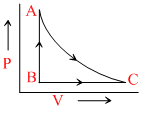
One mole of ideal gas undergoes a cyclic process ACBA as shown in figure. Process AC is adiabatic. The temperatures at A, B and C are 300, 600 and 450 K respectively : - One mole of ideal gas undergoes a cyclic process ACBA as shown in figure. Process AC is adiabatic. The temperatures at A, B and C are 300, 600 and 450 K respectively :
Options
A.In process CA change in internal energy is 225R.
B.In process AB change in internal energy is - 150 R.
C.In process AB change in internal energy is - 225 R.
D.Change in internal energy during the whole cyclic process is + 150 R
Solution
Ans (C)
ᐃUCA = nCV(TA - TC)
1 × R × (300 - 450) = (- 225R)
ᐃUAB = nCV (TB - TA)
1 × R × (600 - 300) = + 450 R
ᐃUBC = nCV (TC - TB)
1 × R × (450 - 600) = - 225R
ᐃUABCA = ᐃUCA = ᐃUAB = ᐃUBC = 0
ᐃUCA = nCV(TA - TC)
1 ×
R × (300 - 450) = (- 225R)ᐃUAB = nCV (TB - TA)
1 ×
R × (600 - 300) = + 450 RᐃUBC = nCV (TC - TB)
1 ×
R × (450 - 600) = - 225RᐃUABCA = ᐃUCA = ᐃUAB = ᐃUBC = 0
Create a free account to view solution
View Solution FreeMore Heat and Thermal Expansion Questions
In a vertical U - tube containing a liquid, the two arms are maintained at different temperatures, t1and t2. The liquid ...The figure shows two thin rods, one made of aluminum [α = 23 × 10-6 (Co)-1] and the other of steel [α = 1...A difference of temperature of 25º C is equivalent to a difference of :...Two identical glass bulbs are interconnected by a thin glass tube at 0oC A gas is filled at N.T.P in these bulb is place...Figure shows the variation of the internal energy U with density ρ of one mole of an ideal monatomic gas for thermo...