Chemical Kinetics and Nuclear ChemistryHard
Question
A substance ″A″ decomposes in solution following the first order kinetics. Flask I contains 1 L of 1 M solution of A and flask II contains 100 mL of 0.6 M solution. After 8 hr. the concentration, of A in flask I becomes 0.25 m. What will be the time for concentration of A in flask II to becomes 0.3 M ?
Options
A.0.4 hr
B.0.4 hr 2.4 hr
C.4.0 hr
D.Unpredictable as rate constant is not given
Solution
Flask I:
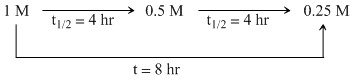
t1/2 = 4 hr.
Flask II:
0.6 M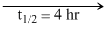 0.3 M
0.3 M
A first order reaction is independent of the initial concentration of the reactant.
Hence, answer is (c).
t1/2 = 4 hr.
Flask II:
0.6 M
0.3 MA first order reaction is independent of the initial concentration of the reactant.
Hence, answer is (c).
Create a free account to view solution
View Solution FreeTopic: Chemical Kinetics and Nuclear Chemistry·Practice all Chemical Kinetics and Nuclear Chemistry questions
More Chemical Kinetics and Nuclear Chemistry Questions
If uranium (mass number 238 and atomic number 92 ) emits an α - particle has mass number and atomic number :...Kinetics can be studied by titration using :...When secondary alkyl halide undergoes SN reaction, it follows SN1 (first-order) and SN2 (second-order) pathway simultane...The suggested mechanism for the reaction CHCl3(g) + Cl2(g) → CCl4(g) + HCl(g) is$${Cl_{2}\overset{\quad K_{1}K_{2}\quad}...The reaction A(g) + 2B(g) → C(g) + D(g) is an elementary process. In an experiment, the initial partial pressure o...