Chemical Kinetics and Nuclear ChemistryHard
Question
The reaction A(g) + 2B(g) → C(g) + D(g) is an elementary process. In an experiment, the initial partial pressure of A and B PA = 0.60 and PB = 0.80 atm. when PC = 0.2 atm, the rate of reaction relative to the initial rate is
Options
A.1/48
B.1/24
C.9/16
D.1/6
Solution
r1 = k[A][B]2 = k[0.6] [0.80]2
After reaction
A + 2B → C + D
0.06 - 0.2 0.8 - 0.4 0.2 0.2
0.4 0.4 0.2 0.2
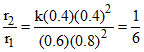
After reaction
A + 2B → C + D
0.06 - 0.2 0.8 - 0.4 0.2 0.2
0.4 0.4 0.2 0.2
Create a free account to view solution
View Solution FreeTopic: Chemical Kinetics and Nuclear Chemistry·Practice all Chemical Kinetics and Nuclear Chemistry questions
More Chemical Kinetics and Nuclear Chemistry Questions
The colloid is :...A reaction which is of first order w.r.t reactant A, has a rate constant 6 min-1. If we start with [A] = 0.5 mol L-1, wh...$A \rightarrow D$ is an endothermic reaction occurring in three steps (elementary).(i) $A \rightarrow B\Delta H_{i} = + ...The rate constant of a reaction depends on :...Activation energy of any chemical reaction can be calculated if one knows the value of...